


Accessible information thanks to AI: RTVE Elecciones Inteligencia Artificial
Real-time election coverage with artificial intelligence for towns with fewer than 1,000 inhabitants.
Published on · Opinion AI Technology People Loneliness
Loneliness is a serious problem in aging, technologically hyperconnected societies. But technology can also help us feel less isolated and transport us to other places.

Some of us don’t like crowds, packed places or even the 10-minute-plus lines to get into a tourist attraction. Walking down Calle Mayor in Madrid at 7 p.m. at Christmas, visiting the Eiffel Tower at peak tourist time, or lining up to take a photo at Piccadilly Circus in London, that classic spot, without thirty people in the background. We wish we could do the same things without being packed in like sardines and without it taking longer than it should.

People say virtual reality may let us visit places from home, without worrying about being surrounded by crowds.
Do you remember the last time you visited somewhere so crowded you didn’t enjoy the experience?
I want you to picture that last experience. Imagine, for example, making that visit without waiting more than an hour to get in, without hearing people shouting or making noise, without getting your feet stepped on, taking photos without people in the background taking photos too; in short, with no stress at all. Instead, imagine visiting that same place with ambient sound in the background, birds chirping and even the sound of a stream flowing. A voice in the background explains what you’re seeing and can give you more details (if you ask) about the history of the place.
Interesting experience, right? New tourism business models are appearing on the horizon.
But is this really what we want?
To enjoy things in peace without anyone bothering us?
To be alone?
I think there are situations where we choose to be alone to make the most of them, but it’s a matter of choice. Here, perhaps we need to design virtual reality products that adapt to those wishes.
Because what would the Shibuya crossing in Tokyo be without people? Surely it wouldn’t be the same, and we’d want to live that virtual experience surrounded by virtual people.
 At the Shibuya crossing in Tokyo, hundreds of people crossing at rush hour. Photo by Finan Akbar on Unsplash.
And what happens when being alone isn’t a matter of choice?
A few days ago I read that in Japan, many lonely elderly people commit minor crimes (like shoplifting) so they’ll be sent to prison. Life in prison is a better alternative than living alone at home.
Lonely older people aren’t just a problem in Japan. Countries like Germany, Italy or Spain (even if it isn’t at the top) also have rapidly aging populations, and the number of older people living alone is rising considerably.
 An elderly woman, photo by Christian Langballe on Unsplash.
In the United Kingdom, they’ve decided to create a “minister for loneliness”. It’s set up as a working group within the ministry for sport and civil society to try to tackle the fact that more than 9 million adults feel lonely “always or often.” And here we’re no longer just talking about a problem among older people; it affects society as a whole.
How can technology help make this lack of connection and communication disappear? This is where the new interaction models that have appeared in recent years can be part of the solution. Among others, virtual reality and conversational interfaces.
In 2016, Facebook launched Spaces, its virtual reality platform for sharing moments with friends in a virtual world. But I’d go further: let’s not assume the solution lies only in social networks, which are sometimes double-edged swords, since using them often and keeping an active profile doesn’t mean you stop feeling lonely.
What happens when being alone isn’t a matter of choice? > […] We’re no longer just talking about a problem among older people; it affects society as a whole…
Today, the only requirement for virtual experiences is a VR headset (it can even be made of cardboard) and a phone or computer that meets the software requirements. Even so, the quality of the experience varies a lot depending on the device you use. And there are still problems, among others with how long you can use the device and with motion sickness.
Conversational interfaces, as an emerging communication channel, will give us the chance to come closer, communicate and, in some way, fight loneliness. Why? Because we’re used to talking to each other, and speaking requires no prior technical knowledge, which makes them accessible to everyone. Talking is the most natural way to interact.
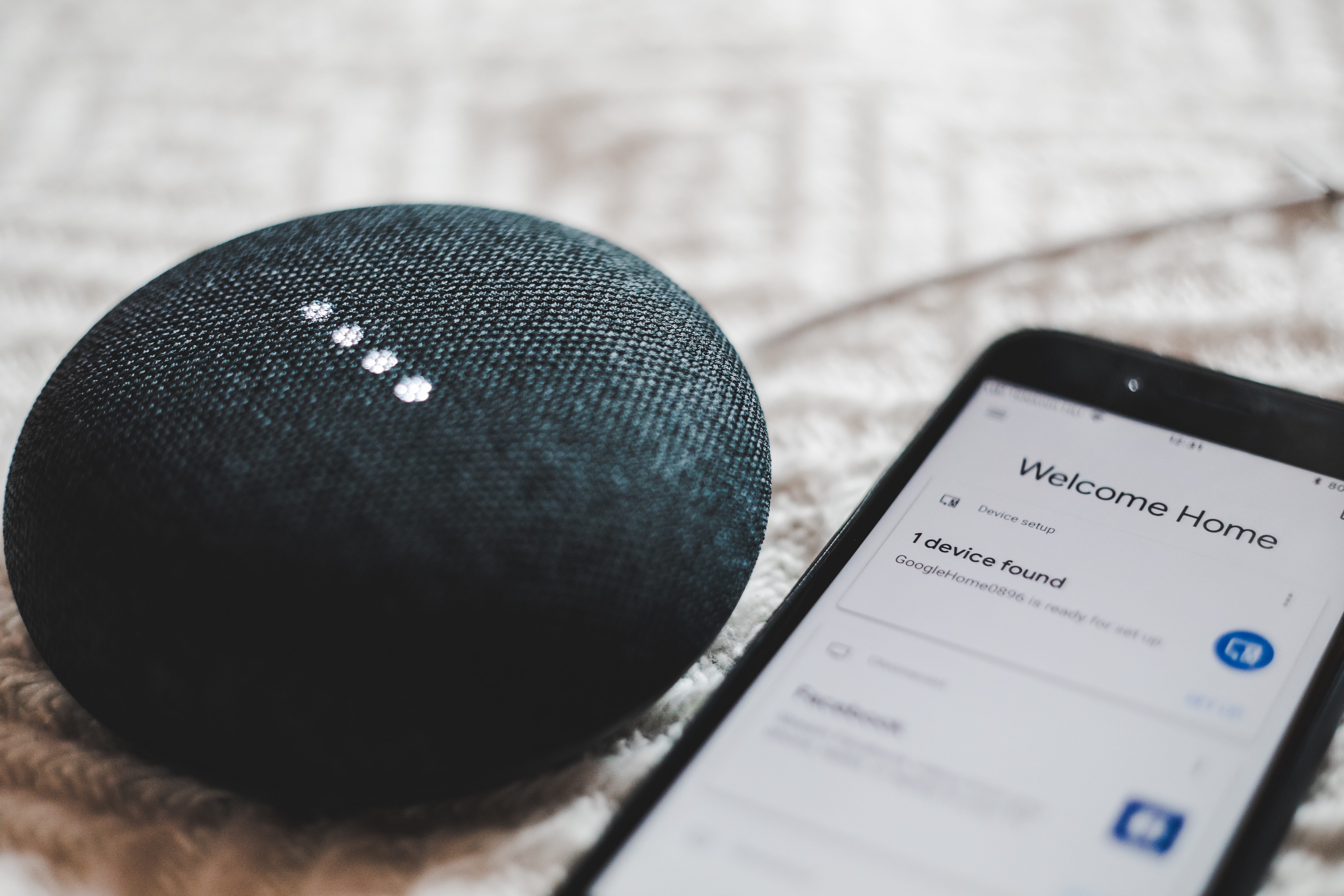 Google Home Mini, a speaker for using Google Assistant. Photo by Bence Boros on Unsplash.
These interfaces can currently be used from mobile devices or from “smart” speakers, mainly by voice, such as Amazon Echo or Google Home. For a few years now we’ve been able to have something like a basic conversation with general assistants like Siri (Apple) or Cortana (Microsoft), to ask them for reminders or other information.
But the most interesting part is that we can now extend these assistants’ capabilities and create all kinds of voice apps. What Google calls Actions for the Google Assistant, and Amazon Alexa calls Skills. So why not use our own skills to give today’s voice assistants “superpowers”?
Talking is the most natural way to interact.
The possibilities here are wide. We can build voice apps, for example, that help older people feel less lonely, asking them what they did that day or connecting family members with each other through audio messages. Or apps that bring us closer to our friends and let us talk to them like a walkie-talkie, even when we’re miles apart. Or more therapeutic apps, where any of us can talk about our emotions.
Can you think of any other examples?
Either way, technology can help. It’s not just science fiction: building the technology of the future is in our hands. There’s a lot left to do. It’s time to come together to meet these needs and build apps that help us fight loneliness. Will you join us?
Cover photo: Loneliness, by Felipe Elioenay on Unsplash

Written by
Co-founder at Monoceros Labs
Co-founder of Monoceros Labs. A computer engineer researching dialogue systems since 2009, now doing a PhD in AI at the University of Granada.
Share this article:
Real-time election coverage with artificial intelligence for towns with fewer than 1,000 inhabitants.

A pioneering project to create an AI-generated voice for PRISA Radio to read sports news, the first of its kind launched in Spain.

Want to know which tools to use to bring your written content to life? Here are a few keys.