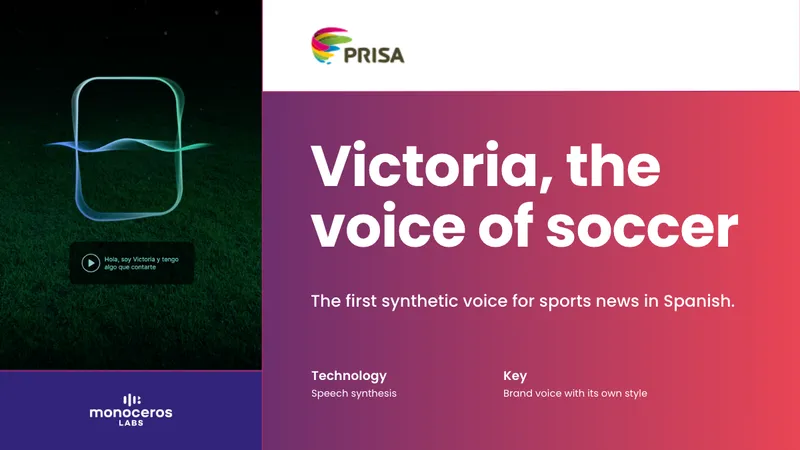
Project Awarded 2023
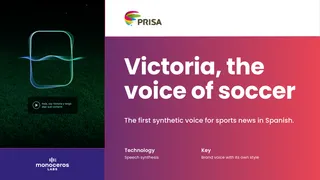
Victoria: the first synthetic voice for sports news in Spanish
A pioneering project to create an AI-generated voice for PRISA Radio to read sports news, the first of its kind launched in Spain.
“We want a voice of our own that sounds like us, not like everybody else.”
Services
We design and train synthetic voices with identity: the voice of a brand, a media outlet or a character. We take care of pronunciation, reading styles and the consent of the people who lend their voice.
Speech synthesis, or text-to-speech, turns any text into audio in a specific voice. A custom brand voice is one only you use, trained for your content in Spanish and its accents. For Victoria, PRISA's voice for sports news, we recorded more than 12 hours in the studio and over 4,200 sentences, which became more than 4 hours of clean audio to train the model.
Together with your team, we define how it should sound: personality, tone and reading styles.
We choose the voice actor, with their consent, or design a voice that doesn't identify any real person. You approve it before we go on.
We write the recording scripts, direct the sessions and prepare the data with phonetic review. For Victoria, that meant over 12 hours in the studio and 4,200 sentences.
We train the model and tune intonation and pacing for each context: news, conversation or narration.
Dictionaries so names, places, acronyms and industry terms are always read correctly.
Use it from your own systems through an API, or from Fonos, our voice and localization studio.
Spanish voices, in all their accents, in Fonos, our voice and localization studio.

We understand the challenge and review what today's technology can do for your case, your language and your data.
We build just enough to validate the idea with real people.
We try it out in your organization, measure and adjust.
We document and train your team so they can keep evolving it.
What you get
Who it's for
A pioneering project to create an AI-generated voice for PRISA Radio to read sports news, the first of its kind launched in Spain.
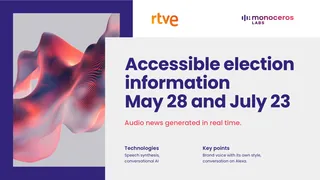
Synthetic voices to make real-time election coverage accessible for towns with fewer than 1,000 inhabitants, an AI project by RTVE.
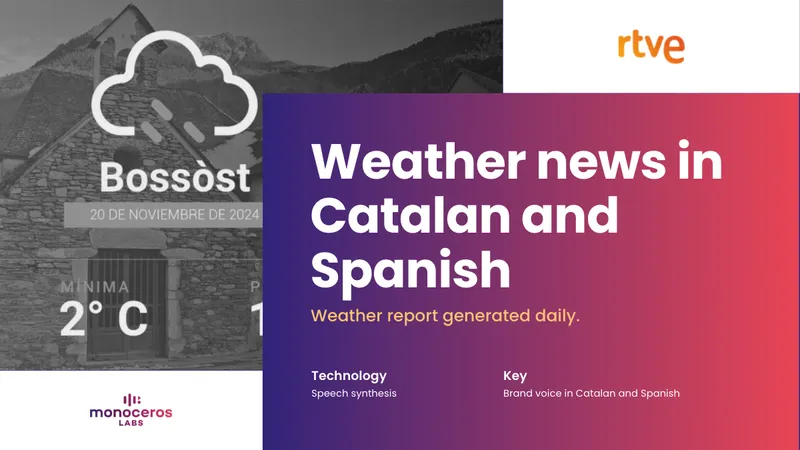
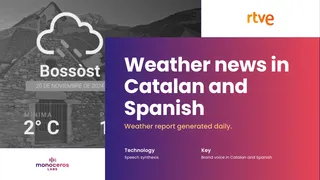
Making local weather information accessible in Spanish and Catalan with AI, an innovative project by RTVE.
An initiative that uses AI to create synthetic voices representing the diversity of the LGBTQ+ community, promoting inclusion and reducing bias in voice technology.
No. Victoria, PRISA's voice for sports news, was designed not to identify any real person. We can also start from a voice actor's voice, always with their consent.
We've built Catalan voices for RTVE and Spanish accents such as Andalusian in Fonos. For each language or accent we assess the available data and the quality we can reach.
Integrated into your systems or through Fonos, our voice and localization studio.
It depends on the quality and the reading styles you need. For Victoria, PRISA's voice for sports news, we recorded more than 12 hours in the studio and over 4,200 sentences written for that purpose, which became just over 4 hours of clean audio after phonetic review. Other uses need far less: from a few seconds of audio for instant (zero-shot) cloning to a minimum of 15 to 30 minutes for professional cloning.
Three things: whether we start from a real person or a designed voice, how many reading styles you need (news, conversation, narration), and how many languages or accents.
Proper names, acronyms and industry terms come out wrong unless it's taught them, which is why we deliver a pronunciation dictionary. A voice trained to read the news won't narrate a story or hold a conversation equally well: each style has to be prepared. Depending on the technology, it can also hallucinate: skip or repeat words, or say something that isn't in the text. And a voice based on a real person is only created with their consent and clear terms of use.
From an idea or a research project to a prototype real people can try.
We design and build AI assistants and agents that converse naturally through voice, text and images, with a personality that fits your brand.
We measure how your assistant talks: what it understands, where it gets lost and when it shouldn't answer.
Conversation design, assistant personality, synthetic voice and conversational AI, taught by the people who build them.
Tell us what you want to achieve. If we're not the right team, we'll say so.