
Project
Catalan synthetic voices for local weather information
Making local weather information accessible in Spanish and Catalan with AI, an innovative project by RTVE.
← All projects
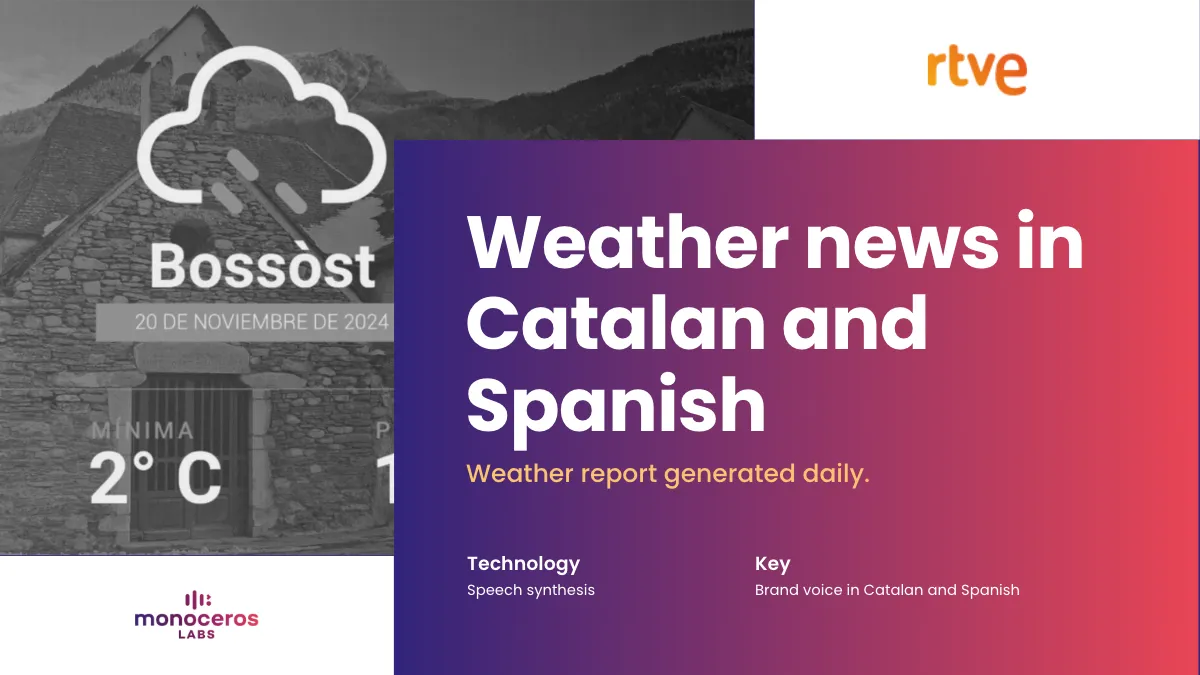
RTVE, Spain’s public broadcaster, led an innovative proof of concept that uses artificial intelligence to make weather information for five towns in Lleida accessible through custom synthetic voices, in both Spanish and Catalan with regional accents.
At Monoceros Labs we contributed our experience in speech synthesis (TTS) to create unique synthetic voices that let people hear the weather forecast in local accents, making the information more familiar and accessible.
The challenge
The weather news generation project, part of RTVE IA, aimed to:
- Automatically generate local content in real time for towns with fewer than 1,000 inhabitants.
- Create natural synthetic voices that respect Catalan accents, specifically those of the Lleida and Barcelona areas.
- Make weather information accessible in different formats.
- Ensure journalistic quality with professional oversight.
- Keep ethical control over the use of the technology.
Our solution
Designing and developing synthetic voices
We created four unique synthetic voices for the project:
- Specialized in reading weather news in a journalistic style.
- Voices in Spanish and Catalan, including dialectal varieties such as the Lleida accent.
- All the voices were generated with generative AI, blending characteristics of different voices with a news-reading style.
- They’re new identities that don’t identify the voices they learned from.
Technical features
The voices were developed with special attention to:
- Accurate pronunciation of the proof-of-concept towns in Catalan and Spanish, and of weather terms, with a specialized phonetic dictionary.
- A natural, professional narration style suited to the content, with intonation and prosody specific to weather information.
Results and impact
Project scope
- Initial coverage of 5 towns in Lleida.
- Weather information in Spanish and Catalan.
- Adaptation to local dialectal varieties.
- Automatic generation of custom audio content.
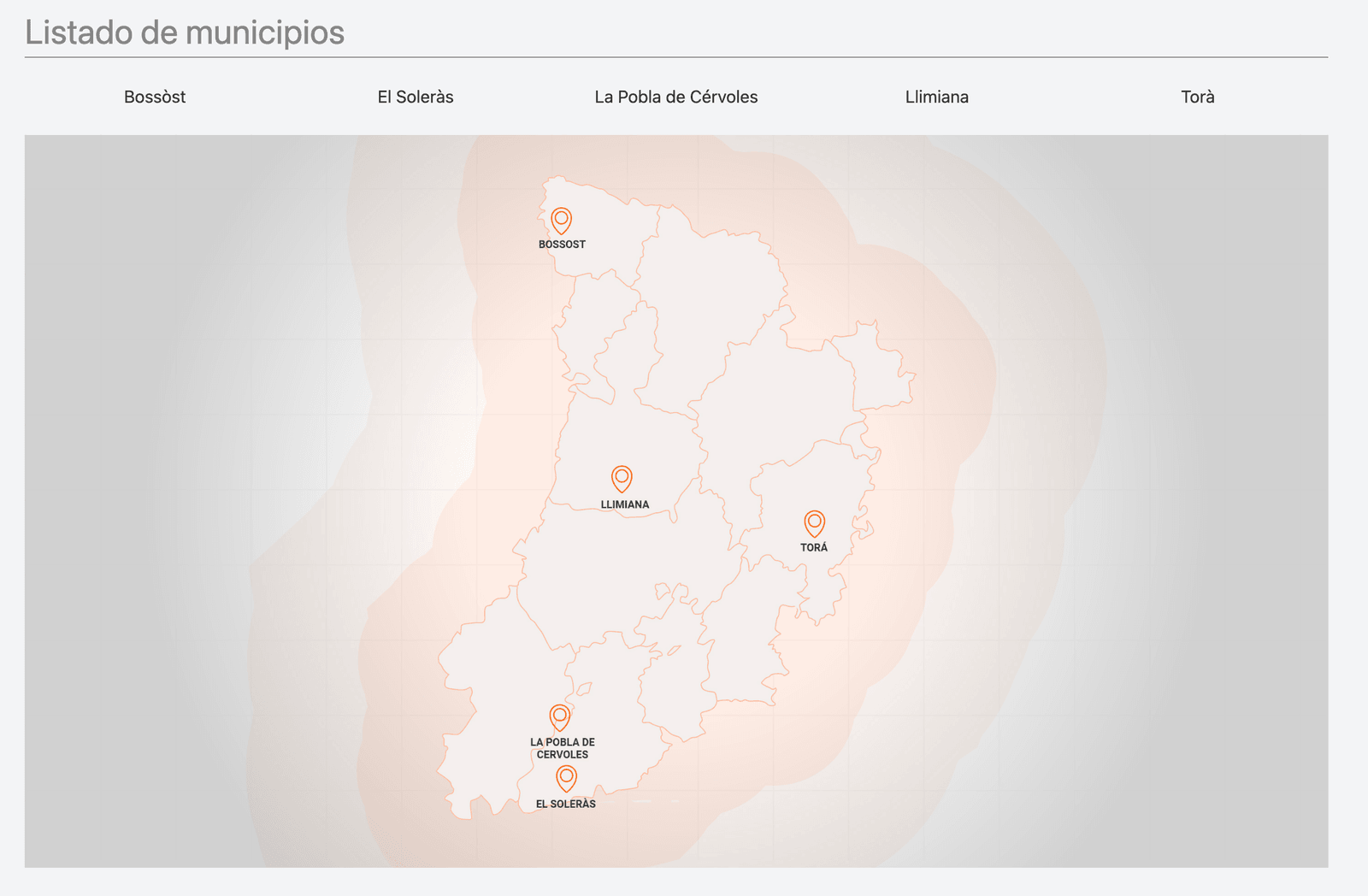 Map of the five towns in Lleida with weather coverage.
Benefits
- Accessibility: content available to people with visual impairments.
- Localization: information adapted to each region, in its own accent.
- Efficiency: automatic content generation while maintaining quality.
- Inclusion: preserving and promoting local language varieties.
- Scalability: the potential to expand to more regions and languages.
Responsible innovation
- Constant oversight by RTVE professionals.
- Transparency in the use of synthetic voices.
- Ethical control over content generation.
- A complement to journalistic work, not a replacement.
What’s new about it
The project stands out for several reasons:
- Language customization: adaptation to Catalan and its local dialects, northwestern (Lleida) and central.
- Ethical AI: unique identities designed without cloning real voices.
- Journalistic quality: professional standards maintained.
- Public service: more accessible information.
- Technological innovation in Catalan: advanced use of generative AI for voice in Spain’s co-official languages, such as Catalan.
Multidisciplinary collaboration
The project involved:
- RTVE: editorial direction and journalistic oversight.
- University of Lleida: linguistic input.
- University of Castilla-La Mancha: journalistic validation.
- Monoceros Labs: design and development of synthetic voices and TTS technology.
- Narrativa: generation of the weather texts.
More information
The project shows how technology can make information more accessible and closer to people, especially in local contexts. Combining AI, synthetic voices and linguistic design made it possible to build a solution that brings weather information to more citizens in an innovative, effective way.
- RTVE leads an innovative AI project for synthetic voices in weather forecasting (in Spanish).
- A university student from Lleida lends his voice to RTVE’s “weather” artificial intelligence (in Spanish).
- RTVE will use AI to read weather news in Catalan for five towns in Lleida (in Spanish).
This project is part of RTVE’s innovation initiatives and involved the collaboration of several institutions.
Related services
Shall we build the next one?
Tell us about your voice or conversation challenge.