


When the agent can see too
Multimodal agents that combine voice, text, images and screens: which channel to use when, what we know about multimodal design, and the new challenges it brings.
Published on · Synthetic voice Responsible AI Conversation design
Do human-sounding synthetic voices still unsettle us? What research says about the uncanny valley in voices, voice clones and AI assistants.
In 1970, a robotics engineer proposed the idea of the uncanny valley, which we still use to explain why some humanlike machines make us uneasy. Half a century later, AI imitates people with remarkable fidelity. AI-generated faces can no longer be told apart from real ones (Nightingale and Farid, 2022), and neither can voice clones (Lavan et al., 2025). Does that imitation unsettle us? Can we see the same paradox in the latest advances in AI? Recent evidence suggests the unease hasn’t gone away. It has moved.
The uncanny valley comes from robotics. In 1970, Masahiro Mori, a Japanese robotics engineer, published a short essay in a little-known Japanese magazine (Mori, 1970), in which he proposed the concept of the uncanny valley, bukimi no tani genshō (不気味の谷現象) (Borody, 2013). His hypothesis was that the more a robot resembles a person, the more affinity we feel toward it, but, paradoxically, only up to a point. Very close to full likeness, affinity plunges and turns into revulsion. That drop is the “valley.”
Affinity ↑
Human likeness →
Mori illustrated it with examples that still work, like a prosthetic hand that looks real until you shake it and feel that it isn’t, or a realistic mask. He added that movement deepens the drop: an almost-human robot is more unsettling when it moves than when it’s still. His advice to designers was cautious: aim for a clearly nonhuman design and stay on the safe side of the curve.
Humanoid robots are still the most visual example. Demos of Ameca, with its near-human facial expressions, are often used to illustrate the classic valley. But the concept has long since left the robotics lab.
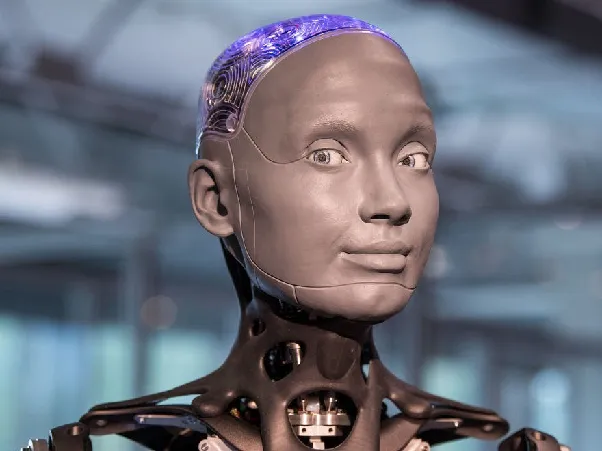
Mori proposed a hypothesis, not an experimental result. Since then, research has confirmed that the uncanny valley effect exists, although it’s narrower and more uneven than its reputation suggests.
The first meta-analysis of the uncanny valley pooled 72 studies and found a large effect. It also showed that each study measures it in its own way: together they used 10 different techniques to create stimuli and 39 different measures of emotional response (Diel et al., 2021). One study with 80 real robot faces, for example, found the “uncanny” curve in two measures. One was how much participants said they liked each robot. The other was their choices in an investment game: they entrusted less money to robots that sat in the valley (Mathur and Reichling, 2016).
The explanation with the most support is perceptual mismatch. What unsettles us isn’t realism itself but an inconsistent mix of human and artificial features, like oversized eyes in an otherwise realistic face (Kätsyri et al., 2015). The alternative idea, that revulsion comes from not knowing whether something is human, has weaker support (MacDorman and Chattopadhyay, 2016).
If inconsistency between perceived features is the key, voice is natural territory for the valley. A 2011 experiment showed this by pairing faces and voices: a robot face with a human voice, or a human face with a synthetic voice, was more unsettling than the matching pairs (Mitchell et al., 2011).
With voice alone, the results are more lukewarm. A study at the University of Potsdam compared one human voice with two synthetic ones: IBM’s Watson text-to-speech service and Sophia, a humanoid robot from Hanson Robotics. The 95 participants rated each voice on qualities such as naturalness, likability and eeriness. The more human a voice seemed, the less eerie they found it (Kühne et al., 2020). Those findings don’t fit the valley paradox. The authors do caution that they compared only three voices, so the study isn’t enough to say whether a vocal valley exists.
A study at Cardiff University looked for a “vocal valley” with three kinds of voices: synthetic, typical human, and human voices altered by distortion or by a voice disorder. With all three together, the data traced a valley. When the researchers separated them, the valley turned out to come from the altered human voices: what unsettled listeners was a voice drifting away from how a person usually sounds. The authors conclude that a voice can fall into the valley, but synthetic voices manage to avoid it (Diel and Lewis, 2024). Another team, at the University of Edinburgh, couldn’t test it with synthetic voices at all: none sounded human enough to get near the valley (Ross et al., 2024).
Voice clones have gone even further. A team at Queen Mary University of London (Lavan et al., 2025) compared human voices with synthetic voices made with ElevenLabs. They used 40 human voices, 40 stock synthetic voices (AI-generated identities from the Voice Design tool) and 40 voices cloned from about four minutes of each person’s recordings. The clones were perceived as just as real as the human voices: in the experiment with clones, 58% of them passed as human, and only 62% of the human voices were correctly identified as human. The stock voices were easier to spot: only 41% passed as human. The study didn’t measure eeriness.
With voice, the problem is no longer sounding robotic. Clones imitate people so well that we can’t tell them apart anymore, and that’s a problem of trust, not of eeriness.
If a synthetic voice already sounds human, what’s missing for it to sound natural in a conversation?
In 2024, Google NotebookLM popularized its Audio Overviews, with two synthetic hosts who hesitate, interrupt each other and use filler words. The Verge described the result as “a bit uncanny” (Roth, 2024).
In 2025, the company Sesame presented its conversational voice model under the title “Crossing the uncanny valley of conversational voice” (Iribe et al., 2025). In its own evaluation, listeners showed no clear preference between isolated sentences recorded by a person and those from the model. But when they first heard the conversation, they preferred the human ones, which the company attributes to its model not yet adapting intonation and pacing to context as well as a person. It’s worth reading for what it is: an evaluation by the company itself.
What does independent research say? That these imperfections have mixed effects. Where breaths are placed affects how natural a synthetic voice sounds (Székely et al., 2020), but added filler words and pauses make it sound less confident (Kirkland et al., 2022; Elmers et al., 2023). Laughter works in a similar way: a soft laugh is judged appropriate and an intense one isn’t (Trouvain and Schröder, 2004).
Some voice agent platforms go further and offer keyboard typing and office noise in the background. Some justify it as a way to avoid awkward silences; others, as a way to make callers believe they’re talking to a person (My AI Front Desk, n.d.; Dasha, n.d.). The only academic study we’ve found on these sounds doesn’t support the practice (Cheng et al., 2026). In it, 24 people talked to a voice assistant that sometimes sounded as if it were doing things in the room, like typing, flipping through a book or pouring water. Those sounds increased the sense that it was present, but worsened how it was rated socially, and participants preferred the versions without them.
It’s worth stressing that none of these studies measures eeriness. They measure naturalness, confidence, presence or likability.
So where is the valley now? One line of research suggests it has shifted from appearance to mind. Psychologists call the impression that something has a mental life “mind perception.” According to a study based on 2,399 surveys, that impression is organized along two dimensions. The first is experience, the capacity to feel, such as hunger or joy. The second is agency, the capacity to act and plan, such as self-control (Gray, Gray and Wegner, 2007).
In a 2012 experiment, 45 participants read about a fictional supercomputer described in one of three ways: as an ordinary computer, as able to act on its own and plan, or as able to feel hunger, fear and other emotions. The version that could feel was far more unsettling (3.27 on a 1-to-5 scale) than the one that could plan (1.36) or the ordinary one (1.22) (Gray and Wegner, 2012). The idea was then tested in virtual reality. 92 people watched the same scene: two digital characters having an emotional, empathetic conversation. The only thing that changed was what participants were told: whether people or a computer controlled the characters, and whether they followed a script or acted autonomously. The scene was more unsettling to those who believed they were watching autonomous AIs, even though the characters’ humanness and attractiveness were rated the same across groups (Stein and Ohler, 2017). The authors called it the “uncanny valley of mind.”
A 2024 paper, however, reanalyzed ten experiments of this kind. It found that machines described as able to feel were much less unsettling when people saw them, in person, on video or in virtual reality, than when they were only described. In a new experiment, convincing participants that a machine felt more didn’t make it more unsettling either. The author concludes that the results favor perceptual explanations of the valley, even if mind perception is “part of the story” (MacDorman, 2024).
Mind perception may not explain Mori’s uncanny valley, but that doesn’t make it irrelevant for today’s assistants. In an opinion piece, Stein and MacDorman (2024) argue that designers have largely sidestepped Mori’s valley by favoring stylized or childlike robots over photorealistic ones. But unease about advances in AI has, in their view, opened a second valley: the rejection of machines that seem to think or feel too much like a person. The question now is how far it’s acceptable for a machine to simulate intelligence, emotion, empathy or creativity. The authors don’t discuss voice assistants, but their argument fits them.
What we believe is behind a message also changes how we judge what we read or hear. The same empathetic responses, generated by a language model, were rated as more empathetic when attributed to a person (Rubin et al., 2025). And the same synthetic voice recording was rated more highly when listeners were told a person, not a machine, had created it (Larson and Fox Tree, 2024).
The most talked-about cases of recent years have nothing to do with voices that sound off. They’re about voices that sound too good.
On top of that, we’re not good detectors. A meta-analysis of 56 papers, with more than 86,000 participants, puts human accuracy at detecting high-quality deepfakes at 55.54%, not significantly different from chance (Diel et al., 2024). For audio the figure was 62.08%, but with very few studies and a margin of error so wide that it’s also consistent with chance. In a study by Spain’s CSIC and Japan’s National Institute of Informatics with 54 Spanish and Japanese listeners, accuracy was 59.11% (San Segundo et al., 2025). To decide whether a voice was human, listeners paid attention to intonation, rhythm and pauses, and also to breathing and laughter: exactly the cues researchers are already learning to synthesize, as we saw in section 5.
An AI voice can also sound more trustworthy than a human one, even while sounding less real. In the first experiment of the Queen Mary University of London study, stock voices were rated as slightly more trustworthy than human ones (57.9 vs. 53.8 on a 0-to-100 scale), even though they were perceived as considerably less real (44.7 vs. 64.0). With clones, the difference in trustworthiness was smaller and not significant (Lavan et al., 2025).
At Monoceros, we create custom synthetic voices, cloned with the speaker’s consent or designed from scratch, with the degree of realism each project needs. We design and build conversational and voice agents whose voice and personality match what the system actually understands, and that say they’re AI from the start. And before they launch, we evaluate them with people: we measure naturalness, and also the trust and the unease they create.
Written by
Co-founder at Monoceros Labs
Co-founder of Monoceros Labs. A computer engineer researching dialogue systems since 2009, now doing a PhD in AI at the University of Granada.
Share this article:
Multimodal agents that combine voice, text, images and screens: which channel to use when, what we know about multimodal design, and the new challenges it brings.
How to design the personality of an AI assistant or agent: role, tone, limits, voice and consistency between what it says and how it sounds. A practical guide.
At IberSpeech 2026 we presented a method that generates a plausible voice from a photo. Here's how it works, what we measured and how far it goes.